
Actionstep’s new marketing message lets lawyers dream of freedom
The day Actionstep decided that it would only serve law firms, everything changed. They went from offering just another workflow software to one of the top legal practice management tools. There was plenty to love about serving lawyers: They’re careful and steady, and almost never switch their software. But they’re also naturally skeptical, and it takes a particular type to earn their trust.
Actionstep’s team is that type. After a period of growth, they brought in Rachel Bryant as SVP of Marketing to ramp up pipeline. She, in turn, called us at Fenwick to help rally the company by devising a message that’d sum up decades of innovation in a sentence everyone could repeat.
"I've worked with Chris and Eve before, and they were the first people I thought of. They don't just execute, they push back when it matters and ask the right questions to get to the real story."

Rachel Bryant
RESULTS
3 regions
4-month sprint
21-person sales certification
Earning love from people who can sue you
Lawyers are logicians and absolutely groan at the junky kind of marketing speak so many software companies use. “Legal tech companies come in from above telling us what to do, but they know absolutely nothing about the practice of law,” complained one lawyer we talked to. As much as marketers love to make claims, lawyers thrill in tearing them apart.
Further, the legal software market had been going through a period of consolidation; most of the top vendors had been scooped up by private equity firms who’d cut staff and jacked up prices. Actionstep was also private-equity owned but intellectually independent. They are a rare type that wants to run a good, long-term business. But how would they differentiate from the rest?
By now, Actionstep served 5,000 law firms across the U.S., Canada, UK, Australia, and New Zealand, which was proof that something was working. This is where Rachel’s work began. All their salespeople across the globe were describing the platform similarly, with regional differences. Though they usually didn’t use a slide deck. All were adapting the message to each customer. And as a result, sometimes prospects would say, “Well, I know you don’t do this one thing,” and the sales reps would yelp, “No, you got us mixed up—that’s the other vendor!”
Rachel’s guidance to us was this: Help us stand out, and get to one true message that cuts through.
“We partnered with Fenwick because we needed more than content. We needed a true thought partner. They have a knack for understanding the end user, the actual person receiving our message, which matters deeply to us because Actionstep is always rooted in our customers first. Together, we've built a brand story and messaging framework consistent enough to trust across every channel, but flexible enough to test and refine in real time as the legal market's understanding of AI evolves."
- Isabel Ramirez, Director of Marketing
One message, three markets
Complicating the situation slightly was all the dialects of English they operated in. Grammar varies in small but important ways across Australia, the UK, and U.S.—in some countries, “solicitor” makes sense, and in others, “lawyer” does. In some, “counsel” isn’t advice—it’s a title. This made finding one message trickier.
Complicating things even further, this industry was just starting to feel the AI disruption. New AI-first entrants were spending lavishly on billboards and celebrity spokespeople and confusing everyone from law firm partners down to their accountants, on what strictly was or wasn’t possible at this point with LLMs. Actionstep was feeling the pressure as prospects asked, “What’s your AI strategy?”
Coming in, Rachel knew they had something special and could see consistency in what they were sharing in different markets. But they were saying so many things, no one knew what the ‘one thing’ was.
How should they be translating and maintaining one message between regions? Was their deliberate and thoughtful approach to AI holding them back? And how could they get to a message that salesfolk would trust and try?
It’s all in how you integrate that message
We at Fenwick are obsessed with integration—meaning: figuring out what happens between when the messaging is agreed upon at the executive level and when it reaches a lawyer’s ear. All too often, it gets telephoned and warped; stripped, shifted, slashed, and grafted, and in the end, salespeople revert to doing whatever they did before.
Rachel and Isabel agreed it’d be best to train the sales team on the new message with a lightweight certification process, then pull the message through the website and campaigns.
With that, we kicked off our process:
We did a lot of reading and research to craft personalized questions for the executives on the revenue and product team, and facilitated several conversations. Brand messaging isn’t about what the product does—it’s about who the company is, and that’s a terribly difficult thing to see from the inside.

Then we went on a listening tour, interviewing 10 team members across product and sales, in all three regions. “Reading between the lines, ‘configurability’ kept coming up,” says Eve Eden, Fenwick Co-Founder. “I clock when someone is telling a story and keeps touching on the same thing multiple times in different ways without realizing it.” We accumulated a few dozen hours of recordings.

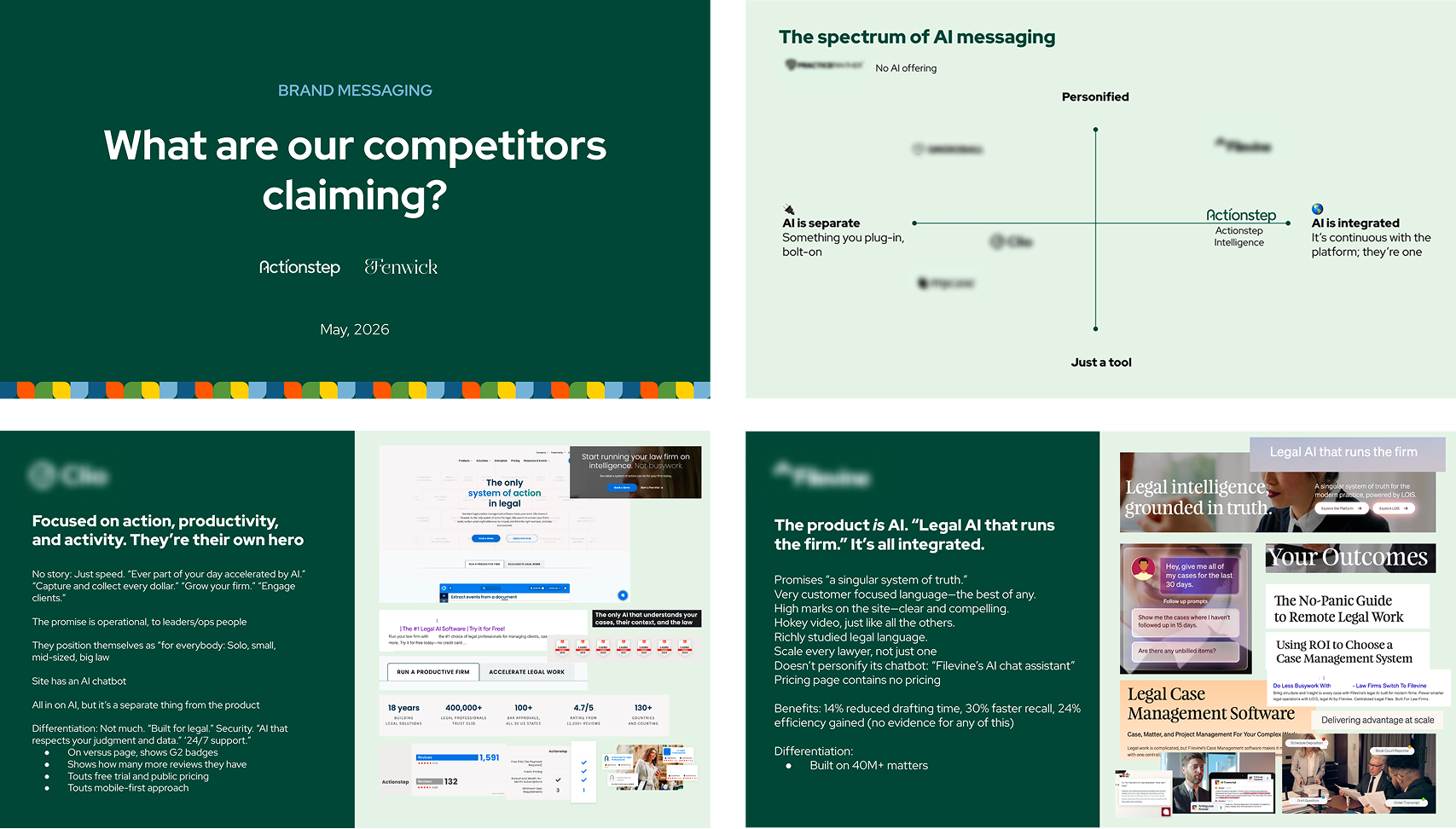
Then Eve talked to prospective buyers, lawyers, partners, and other legaltech founders, while Chris did a competitive teardown of the public messaging of all their top competitors. We don’t overfocus on the competition—ultimately, your message should be a pure broadcast of your company’s truth—but the competitors’ positions do tell us about the buyer we all serve. And in this case, the competition was serving them poorly.
No competitor had anything close to positioning on their site—positioning being defined as “conveying a unique value you uniquely satisfy, which matters to your buyer.” Instead, they were all talking about the product, as if only details mattered and no alternatives existed.
And this is what Actionstep’s sales team had fallen into as well. Most sales teams gravitate to what feels easy and defensible, which is features, without realizing that 70% of the sale is emotional. People buy because they think you are the team who can solve their problem. They need to know you. They need a story.
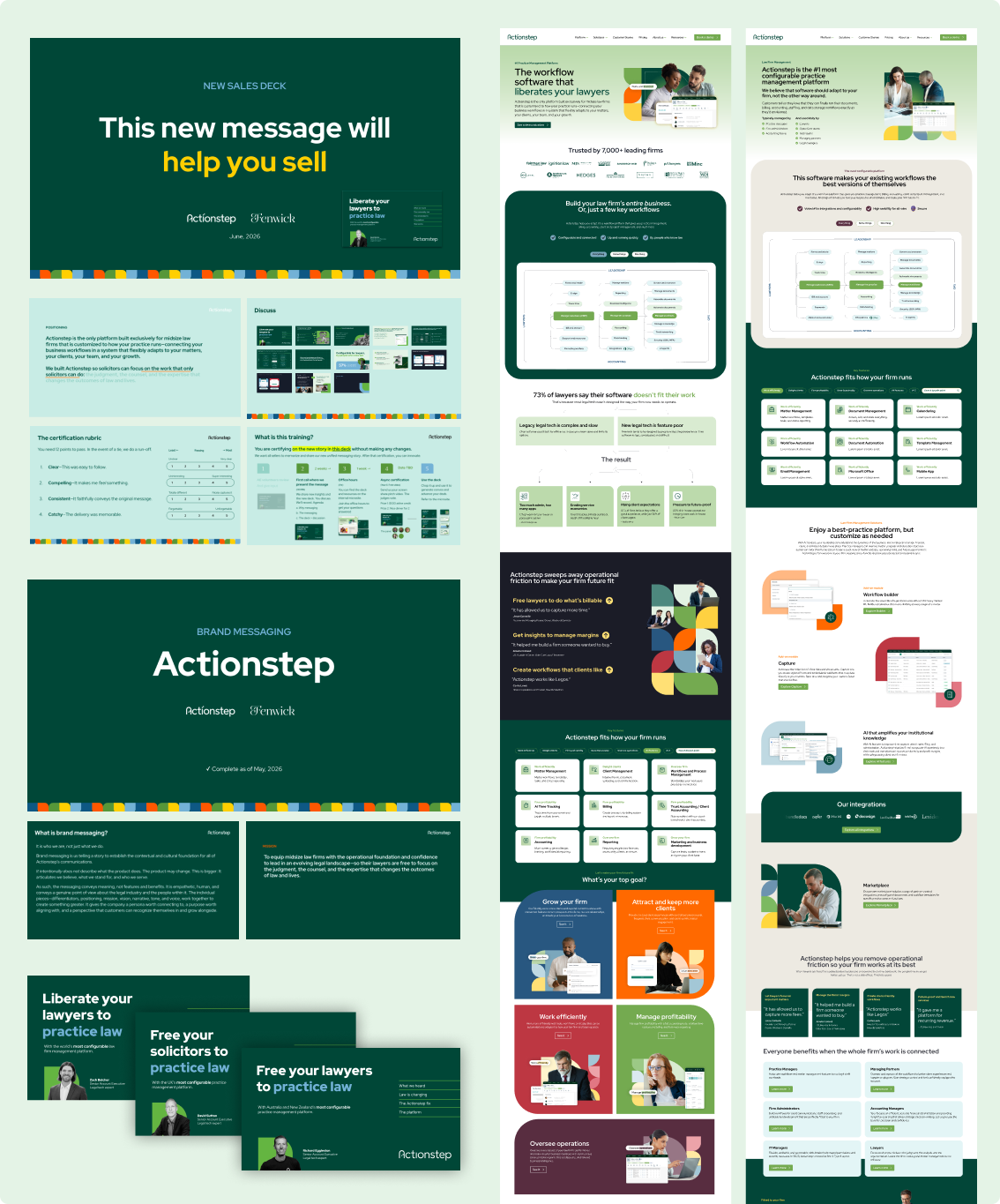
“This one was pretty clear,” says Eve. “There were key messages that kept coming up, and the whole legal industry was obsessed with proofing for the future, but nobody was asking the harder questions or calling out what buyers were explicitly afraid of.” Our job is to identify those key emotional notes, isolate them, and reflect them back. Which we presented in a deck.
“Part of what you’re doing in messaging is confirming to someone that you are seeing them,” says Eve. “That you’re hearing what matters to them, how they describe their pain, and what’s happening in your company’s culture that connects to it. You’re taking core parts of the internal culture and turning them outward.”
We folded all the feedback in, tied off connective threads, and the resulting messaging deck left the executive team elated—because it was what they’d all been saying, only now, simple and clear enough to repeat. Now it was just the one thing that hundreds of people across three slightly varying regions could all say and made sense.
We then tested it with a top seller in each region, who helped us regionalize the deck and clarify when it’d be used and how.
With that framework, we could easily stretch it across the AI story, which was obvious: Lawyers are risk-averse. They appreciated Actionstep’s deliberate approach, and the fact that it was woven throughout the platform—not some bolted-on feature. We also worked up a sales certification process. Rachel and Isabel held to the line on salespeople’s pushback: You will get to personalize this deck and practice your selling art. BUT, first, we’re all going to learn one message, as it’s written here.
The new message bought them more focus
When we tested the new, messaging-enriched site designs against the old, prospects rated the new one 40% higher. They found it easier to understand what Actionstep did, and to find the information they needed. And when the product marketing team analyzed 700 recent buyer calls, the resulting word cloud fit the messaging perfectly: Actionstep wins on configurability.
As that started to sink in at all levels of the go-to-market, it meant people could move faster.
“Messaging gives you the foundation from which to decide what pieces of the story to tell,” says Eve. “It connects all the pieces and unites sales and marketing and helps everyone stop always asking, ‘What should we say?’ That cohesion is felt outside—when all the ads and pages and emails deliver one message, and then sales repeats that same thing, you stand apart as the one vendor who told all others how you were different.”
Which, in Actionstep’s case, was a smashing success, because the core culture we externalized was based on truth. And given the range of software options which would define the next 20 years of their firm, lawyers overwhelmingly chose Actionstep. Because of who they are.
“I’m proud that it feels like we really heard them and that the messaging really landed with not only Actionstep internally, but their customers, and was a true reflection of what they felt proud of in their internal culture,” says Eve. “It brought those two things together and made clear that they aren’t in opposition, which is a winning position.”