
Pilot bet on quality and hit 136% of pipeline
Pilot chose the hard route: they sell services, but also software. While peers were building pure apps, Pilot wrote an accounting software for themselves while delivering bookkeeping, accounting, and CFO help via a team of talented people across the country. It worked well and propelled them to a $1 billion valuation, at which point they looked for their next phase of growth, and brought in Maebellyne Ventura to take over all of demand.
Maebellyne knew that just as unorthodox as Pilot’s product was, its marketing had been even more so. She’d have to build foundational infrastructure like a design system and messaging. She called upon us at Fenwick to be her creative team while she got set up, and we kicked off with the goal of getting in and producing quickly while also proving that they could do less and grow more if the work was high quality.
"Chris being our creative director meant I didn’t have to build a whole creative team. And means I got to delay making a few hires because I had really smart copy, brand concepts, creative direction, design, the whole thing."

Maebellyne Ventura
RESULTS
18 months
136% of pipeline goal
16x conversion lift
They needed to sprint
Pilot hadn’t had a brand marketer in a long time and their identity showed wear. The muted purple, sans serif font, and stock characters recalled early 2010s consumer tech. Meanwhile, they'd lost team members, assets had sprawled, and lots of people creating campaigns in isolation. That’s not atypical in B2B marketing and in Pilot’s case, it was working well, it just wouldn’t scale. Their technical co-founders had launched a salary report covered by Fast Company which had just netted 7,000 leads, but it required a lot of rework each year.
Coming in, we faced the question of, how could we get the creative systematized so the marketers could spend more time on the parts that really benefitted from a human touch?
Maebellyne’s other objective was to open a second, larger market: Selling to small businesses. Pilot had focused exclusively on venture-funded startups and was well known in the venture community. But small businesses—really, a dozen markets in one, from ecommerce to trucking—could be a real growth engine if the product and team could adapt.
“This was a lot at once and I needed people I could trust who could deliver quickly,” Maebellyne recalls. “I knew upfront content would play a big part, but we needed to fill in so many blanks that I couldn’t just go hire a bunch of freelancers and stick them together, I needed a team. Plus, I’m a believer that writing cannot be abstracted from the design.”
“We needed to fill in so many blanks that I couldn’t just go hire a bunch of freelancers and stick them together, I needed a team."
This all made us at Fenwick a good fit—we offer writing and design together, never separately. Because you can’t beat a writer and designer who have hundreds of hours co-working and know each others’ moods and changes.
Further, Maebellyne needed a creative strategist just as relentlessly focused on uncovering insights as her. “I was looking for an agency that could do discovery and really figure out our ideal buyer with us,” she says. “I will listen to every single sales call, to consume all I can about the target audience, and I knew Fenwick would too.”
We kicked off as we always do, with a bit of strategy, which starts with identifying blockers.
One was the sprawl. The blog and resources pages lived on separate URLs. Many of the most important assets like calculators were hidden a few clicks deep. The demand marketers received constant requests from sales to find things that should have been findable.
Two, their visuals presented a mixed message. Pilot offers accounting and CFO work and prides itself in extreme precision. The graphics on their website, however, were amorphous and cheery. Their icons were squishy. And the soft, faded purple said, “unremarkable” when in fact they were achieving brilliant things for clients.
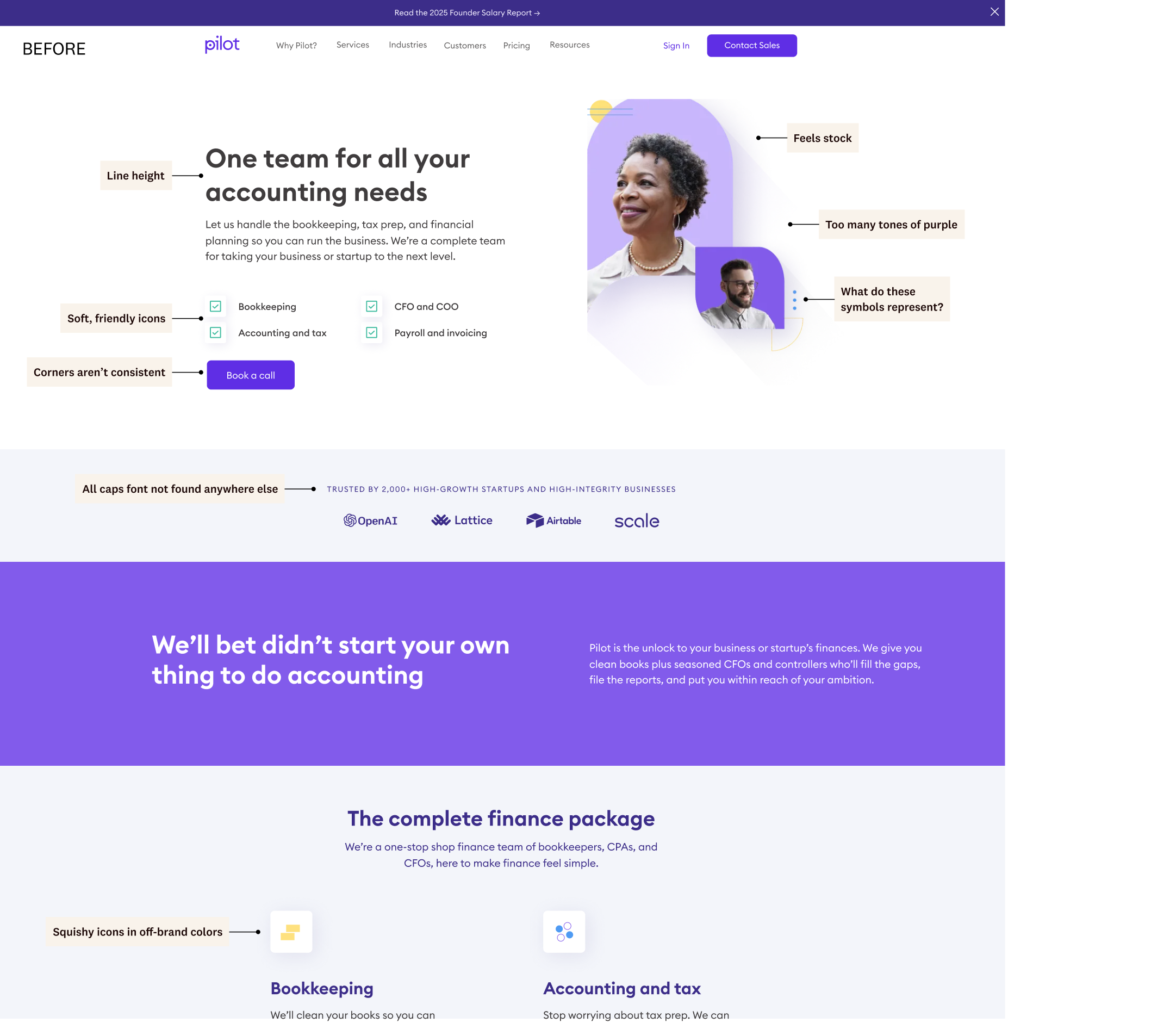
Three, their customer testimonials and case studies were out-of-date. The speakers all worked at startups, not small businesses.
Meanwhile, their tone wasn’t defined and ranged from the founders’ spare precision to bright, cheerful, exclamation-filled webinar invites.
And salespeople were focusing so heavily on the product that there wasn’t a story; calls were either quick to close or long-suffering affairs. Where salespeople did tell a story, it was strictly focused on startups.
We laid out a complete content strategy and calendar including and just as soon as it was done, lead volumes dipped and we inherited the salary report and case study program. The demand demands took over.
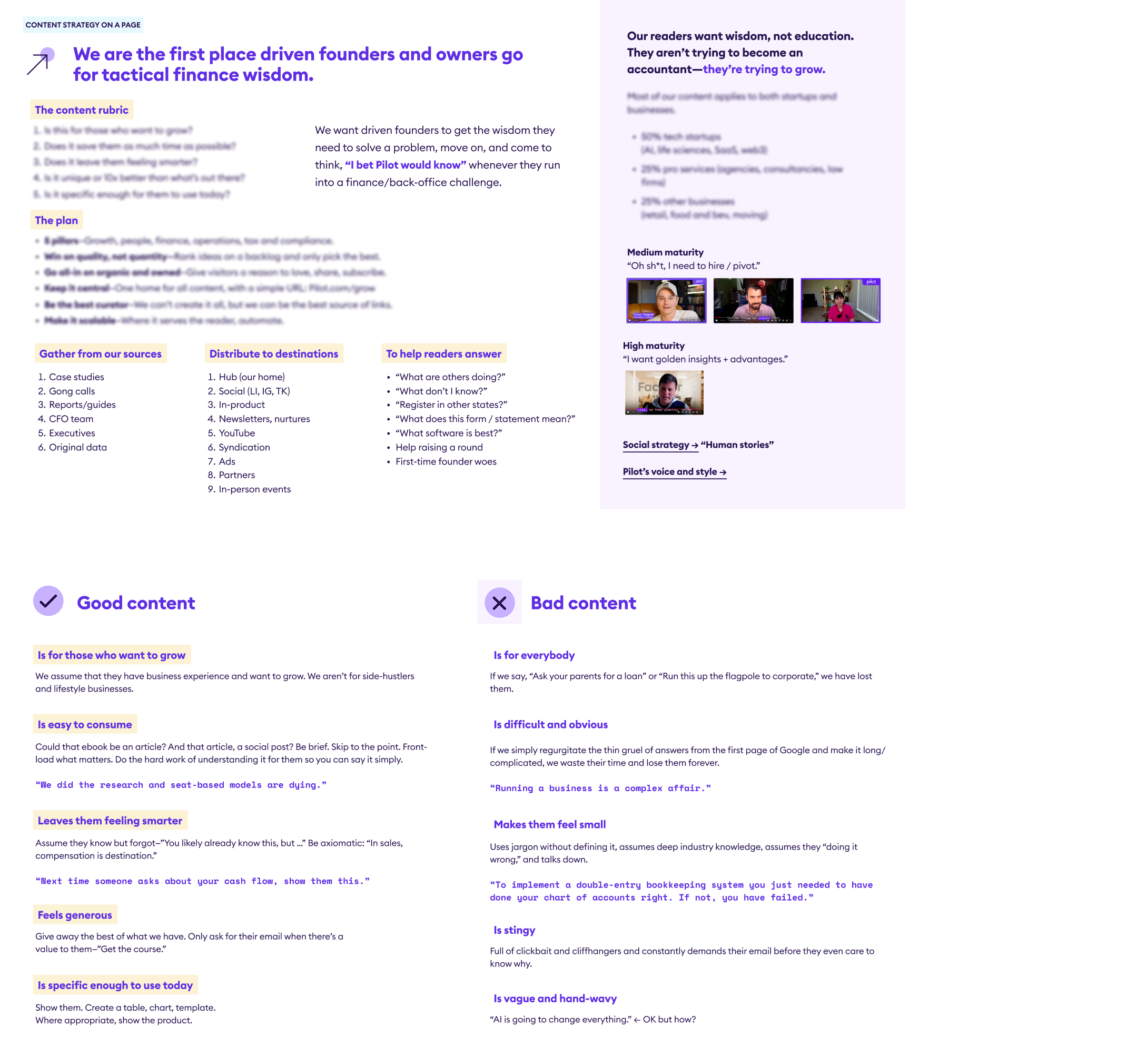
Furiously improving parts in flight
For 18 months we served as Pilot’s creative studio of record using our retainer service to triage and handle all manner of requests. Chris acted as creative director and primary point of contact, and sought to convert all requests back into tasks that’d help build the overall system; to turn all the blog thumbnails into an intelligible mosaic. We sought to establish a new level of quality, and make it institutional.
We held writer’s room meetings, a weekly update with all marketers, and rode along with product marketing, social, demand, email to learn, fix, and file.
“Chris being our creative director meant I didn’t have to build a whole creative team,” says Maebellyene, “And means I got to delay making a few hires for quite a while because I had really smart copy, brand concepts, creative direction, design, the whole thing.”
Meanwhile, Eve and her team skirted the fray and worked on the foundation. She pulled the founder-CEO and head of sales into a messaging sprint to identify, what beyond the product was a story worth telling? Turns out, there was a ton of great stuff that wasn’t being voiced externally. The CEO cared about small businesses because several family members were owners and she saw the struggle. Pilot’s accounting and CFO services were, in a large sense, an act of service, putting mainstreet cafes and marketing agency owners in the room with a CFO advisor formerly at Goldman Sachs. It was top-tier financial advice for folks who’d prior had their aunt doing their books.
Eve called this “access is opportunity” and formulated positioning and a brand messaging deck.
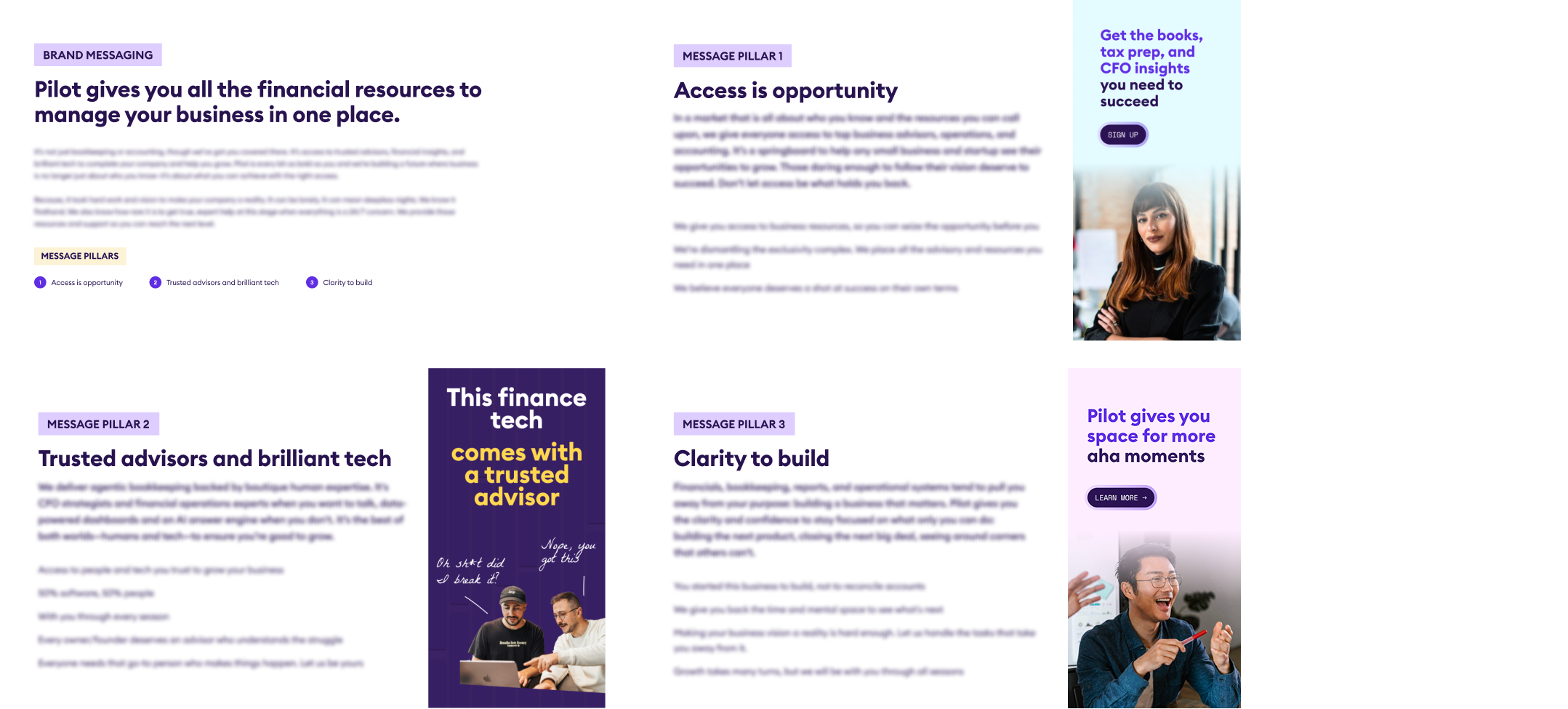
“Chris and Eve are great together because Eve will push on the brand and the feeling and the immersion, then Chris always brings it back to, what is the thing we need to do this week to hit our pipeline number?,” says Maebellyne.
Early wins proved the process. Fenwick used our listening tour transcripts to rapidly redesign and rewrite 20 core landing pages. Pilot expected a 3% lift. They saw a 52% lift.

“This meant that we were getting the highest compliment you can get from prospects which is, ‘I feel seen. That feels written for me,’” says Maebellyne, “because it really spoke to the pain.” As Eve and team tuned up the message and narrative, we wove those new lines into our work churning out all that a fast-growing, eight-person marketing team needed:
- 45+ landing pages
- An ever-on lead magnet
- 32 case studies
- 120 customer videos, including vertical
- 5 animated explainer videos
- The annual salary report
- 12 PDF downloadables
- 60 articles
- 100s of social posts
As we went, we never stopped documenting the work and building templates. We turned the brand messaging into a style guide and then into a design system and website overhaul that made Pilot look vastly more accurate. And bold, and high-contrast enough to stand out in a field that had grown crowded.
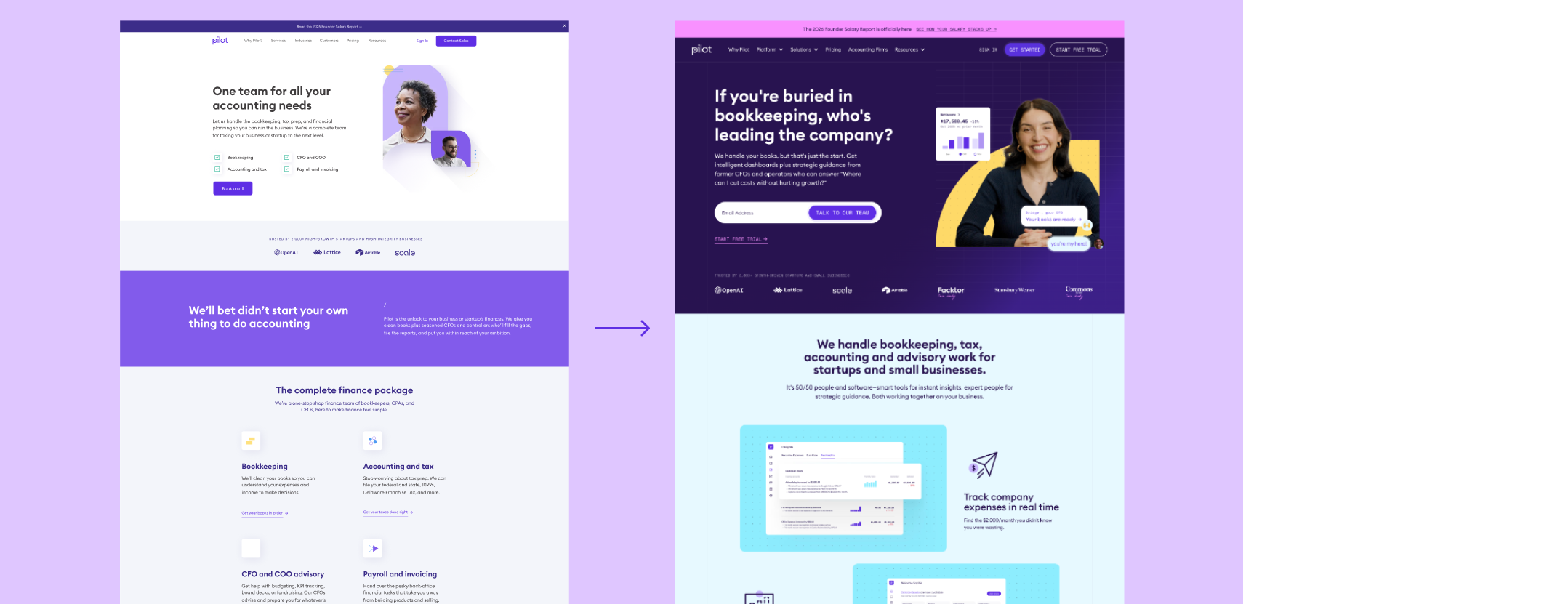
The results: Fewer leads got them to 136% of their pipeline goal
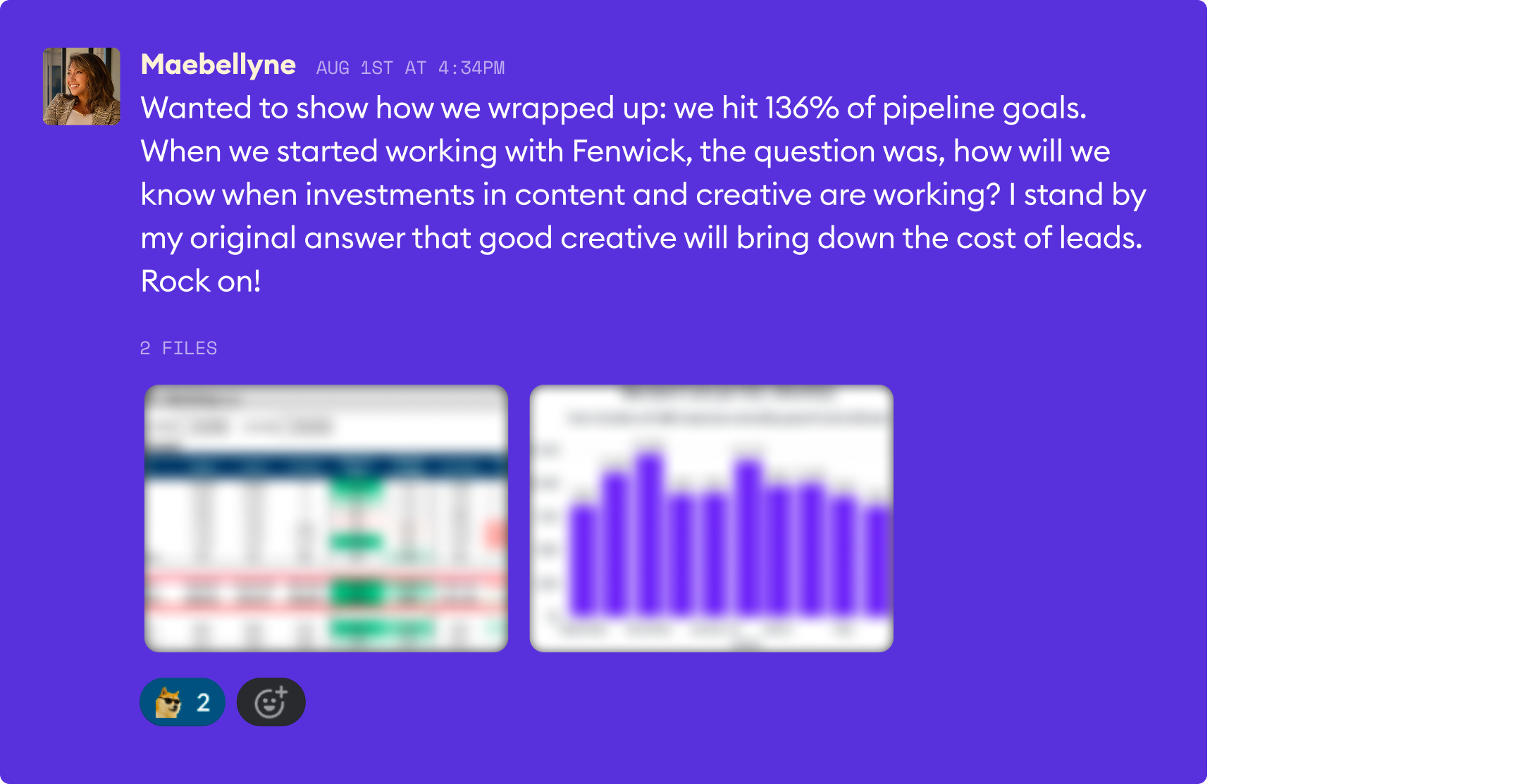
Over the first year, Pilot grew its customer base 52%. Some segments of the small business market proved profitable, and the ultimate win came in the form of bad news that was really good news: They’d missed their sales qualified lead goals … but hit 136% of pipeline goals and had back-to-back quarters of revenue growth.
Meanwhile, Fenwick created sales training materials and a new deck with the updated messaging. And Pilot’s co-founder presented the brand message about giving small businesses the opportunities they were ready for, at Intuit’s conference, Connect.
“There’s no way I could have hired a team of five that knew accounting and our space,” says Maebellyne. “And the all-in-one-ness was great. I know the cast of characters, Clarissa, Chloe, and others, but there was always one person accountable who understood our strategy. In the end I procrastinated far too long not hiring a head of content or creative director because we had you.”
In the end, we at Fenwick made ourselves expendable which is exactly what we like. Pilot hired a head of design who turned the Figma brand system into a living, conversational document that let them produce web pages, product screens, and ads automatically. The brand messaging helped grow deal sizes. And Fenwick faded out as they finally hired a new head of content—who inherited a department in motion.