Report 6 | Jan 26, 2025 | Sign up for this twice-monthly newsletter
Eve recently pointed to the mushrooming guide and knife on our shelf and wondered aloud if they hadn't been the best gift. She'd given them to me a few years ago, and they never seemed to move.

"Oh just the opposite!" I cried, with more force than I expected. They connect me to the outside. They are talismans. And in that way, they've restored my sense of natural time. You see, whenever water vaporizes over the vast Pacific and clouds darken our redwooded coast, the light outside my window grays.
This draws my eye to the book–and the book opens my mind to the earth. I know the wild is calling; mushrooms are imminent to grow.
Thus, book and knife send me shuffling outdoors with a parka, on an excursion I know—I think?—I've chosen. Because that’s what truly fascinates me about mushrooms. They are signs from an alien life bidding us to do their will. And they keep bidding me away from work.
Powerful messengers
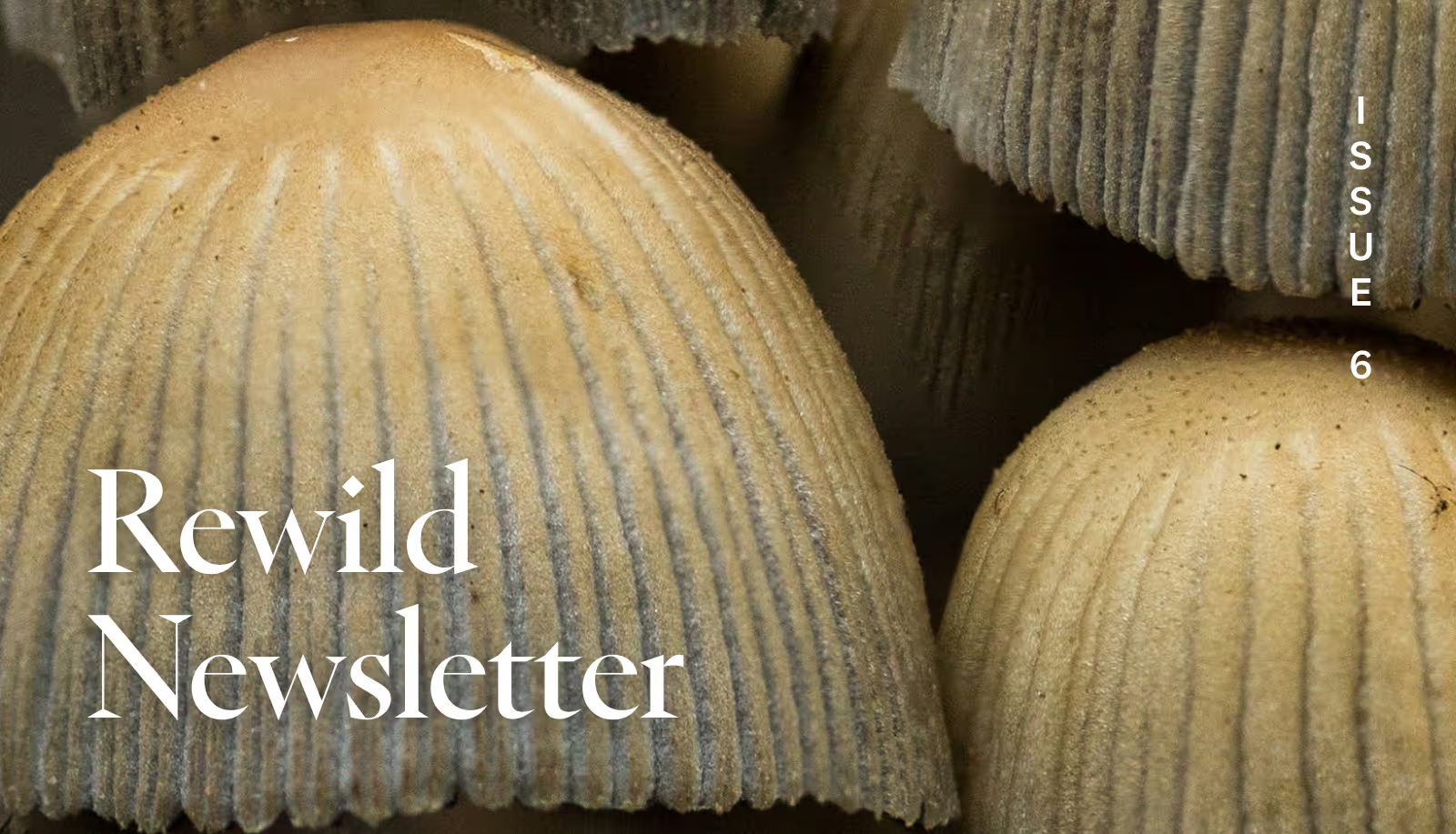
Mushrooms, as many of us know, are mostly invisible. We see their fruiting bodies, but the true creature is the imperceptible mycelial network of fibers that dig into earth and wood to transmit nutrients.
We animals tend to see our own bodies as continuous with ourselves, but for mushrooms, bodies are disposable. The stipe and stem, cap and stalk are ephemeral creations that mushrooms invented to pass along spores. We fear our bodies being eaten. Mushrooms intend it.
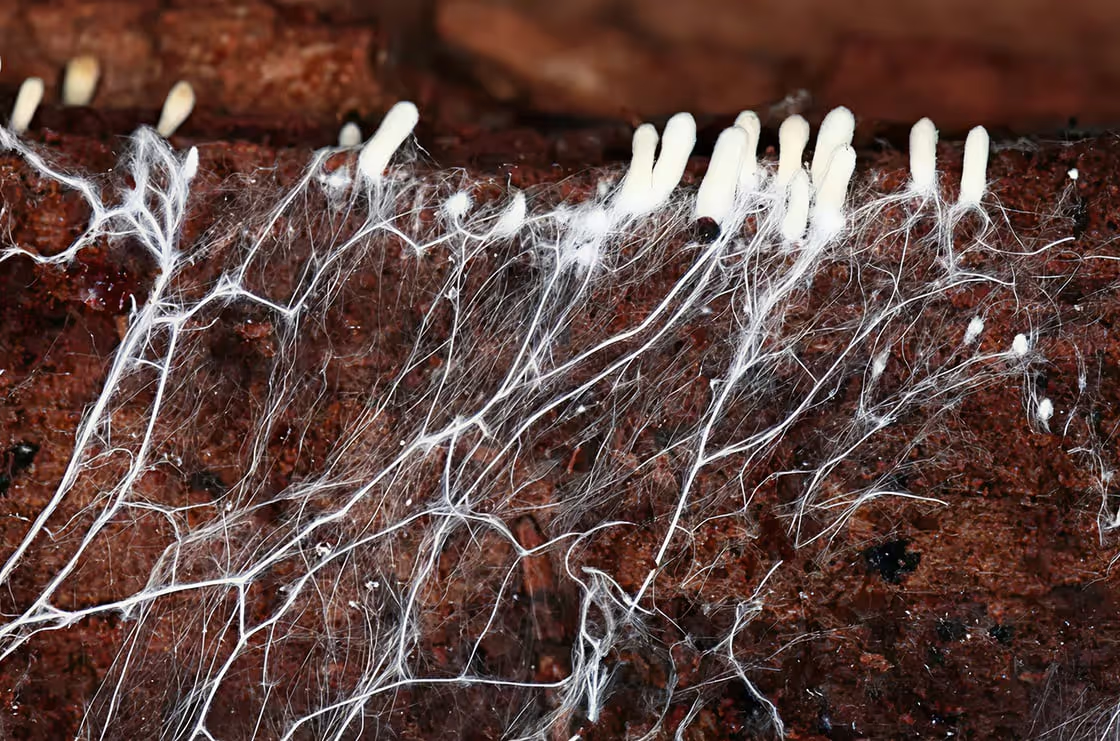
The colorful caps you see poking up—the parts we most readily relate to—are a signal from that very alien life form that split off from a common ancestor 800 million years ago. The mushroom body itself is a piñata. Which they invented for us. It’s really no different from us beaming radio waves deep into space—a signal to a foreign civilization. To them, the loss of that body is no more regrettable than to us, the aluminum craft.
We occupy two parallel and mutually ignorant worlds, we and mushrooms. But we interact upon their choosing, when the conditions are right. And it’s only then that we even recognize that we share the forest with them. My guidebook? It has fallen for their ploy. Nowhere in its 600 pages is there any direction on identifying mushrooms by the actual creature, via the spore button or mycelia. The whole book is written about their lures, the radiant fruiting bodies.

I have never eaten anything I’ve foraged, for I do not yet speak mushroom. If I were to accidentally eat the pearly white Amanita phalloides so common now in California, I’d develop stomach cramps, then my kidneys would rapidly fail; perhaps depositing me as mushroom mulch. Others, like the Psilocybe cyanescens, bruise blue, and a handful are enough to cast me into a 12-hour inward journey. Many who try them emerge with a suspiciously clear obsession with getting others to try—and spread?—said mushrooms.
Even the non-active kind are plenty to draw the eye, and keep me hiking in search.

And this is how those gifts from my wife, book and knife, have restored my sense of time. Whenever the sun dims over the Pacific and rain clouds trouble my sight, I know I must go to marvel at something so clever as to solicit my marveling.
Work application: Send more signals. Perhaps this is a stretch, but when I see fruiting mushrooms, I see communications. Some subtle. Some unmistakable. Lots of companies think their own mere existence is enough to be known but I promise, you need to be louder and more frequent if anyone's to find you twice.
Inspiring principle: Share the Lore
Most knowledge is undocumented. Most of what everyone else—bosses, coworkers, agencies—need to know lies hidden beneath the cognitive surface. that's why it's all our jobs to methodically volunteer information and ceaselessly overcommunicate.
Inside Fenwick
Issue 2 of Rewild Magazine is out: Beautiful Conspiracy. It features the story of a friend and artist who metabolizes negative news into art, and most recently invited me to dive for sea urchins.
The next two issues are under development:
#3. Nature Did it Better—about times bio-logic outsmarted tech.
#4. A Guild of Your Own—about the micro-communities we form.

Worth reading
What can slime mold teach us about biological memory? Long read. Big idea. Slime molds hold memories without having brains, and we don’t know how.
Strategic sociopathy. How do you write about the 10 best CMSes when the world’s burning down?
Alamy. Humanistic stock photos.
Tacit. A new series by Stripe interviewing masters in their craft.
Systems kick back is an observation of how when you try to change an existing system, the system resists change. It even grows violent and “kicks back.”
Typograph is an “AI” tool for inventing typefaces. I can see no use for it. We’re in a strange time where people are obsessed with creating things that nobody else particularly wants.
Prompt pretend. To the above point, AI doesn’t think. And AI doesn’t take on characters. This scientific study shows that asking ChatGPT to be “an accountant” or “a growth marketing expert” has no impact on its responses. As I’ve written from the start, it’s a fabulously talented improviser with no common sense.
What happens when the junior jobs disappear?
You can’t be for everyone. Examples of brands standing out by daring to be difficult.
History Maps. A fun project to map historical objects.
“It’s just a bomb.” Splendid reportage reconstructed from court filings and eyewitness testimony about a man who shows up at a hospital with a bomb, and the stranger who talked him out of detonating it.
Internet artifacts. You may touch the artifacts.