The wind bites as I arrive at the warehouse. It’s still early, and the air that blusters over the building’s smooth, white facade is brackish from the San Francisco bay. It whips across the main thoroughfare, pushing me into the cool, vast halls of the building.

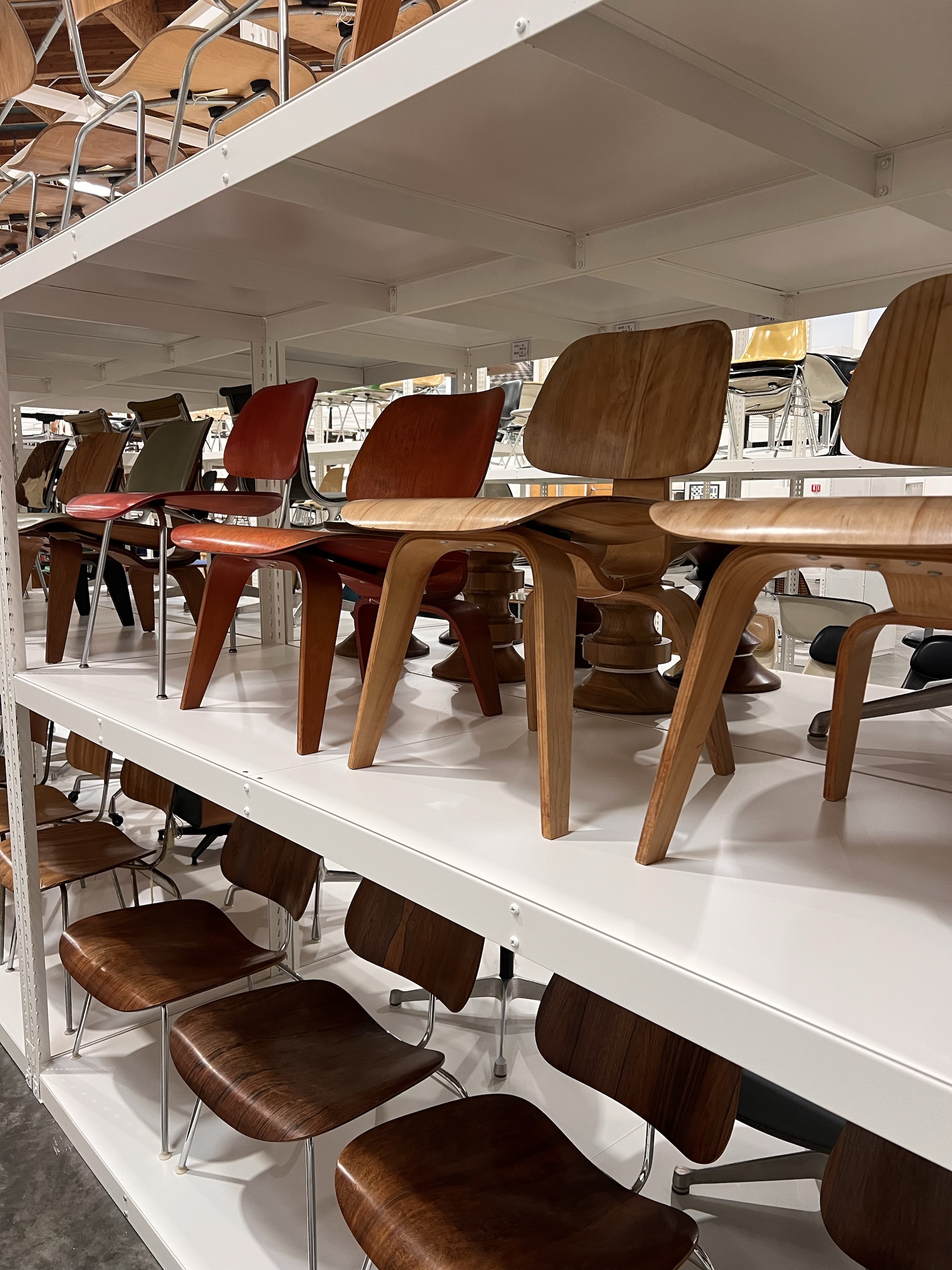
I’m at the Eames Institute of Infinite Curiosity, a nonprofit dedicated to preserving the legacy of Ray and Charles Eames, the couple that pioneered midcentury design as we know it. Though they lived and worked in Los Angeles for 40 years, roughly 40,000 objects from their collection are right here, in an unassuming building next to the freeway in Richmond. Better yet, the archives are open and available to the public, and I happen to have the coolest job in the world: archive tour guide.
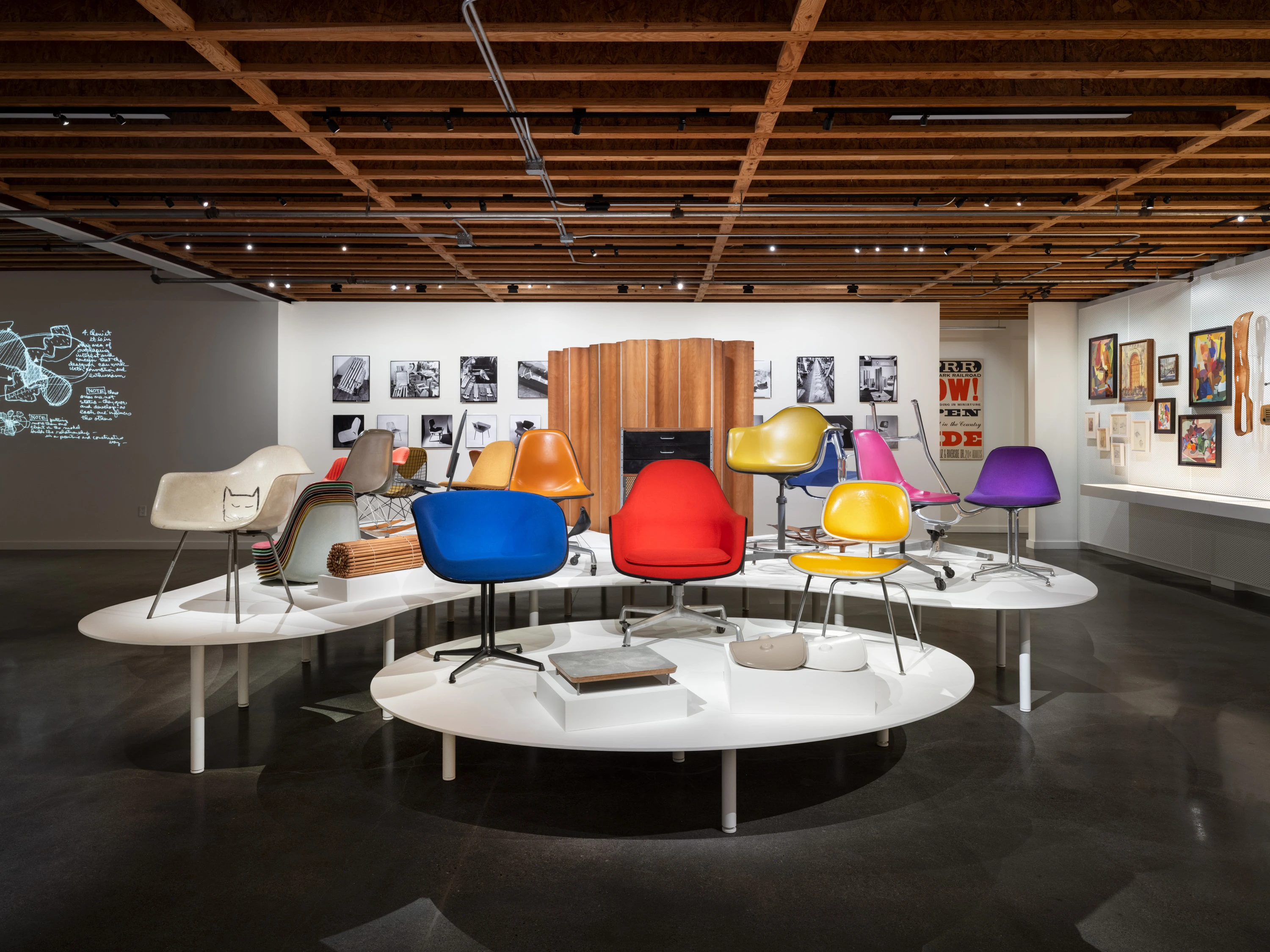
Over the next 90 minutes, my colleague Bridget and I unspool the thread of the designers’ legacy, beckoning our guests to follow us through towering shelves and rows of furniture. We discuss the plywood shell prototypes, the loose cushion armchairs, the wooden elephant, the handwritten ephemera. I demonstrate the musical tower, a 15-foot vertical xylophone that plays a tune when you drop a marble down the hatch.
People have come to hear about the Eameses for many reasons. They are industrial designers and furniture makers, filmmakers and students, all drawn by having experienced the couple’s artifacts: a stackable school chair, a tandem airport seat, the iconic lounge chair and ottoman.
I’m here to touch on all of that—after all, Ray and Charles are best known for their furniture. But I’m also here to explain that Ray and Charles were also some of the first modern designers whose reverence for nature translated into deep environmental considerations within their work. On its surface, furniture design seems like a pretty indoorsy endeavor. For Ray and Charles, it was anything but.
Three hundred miles south in Los Angeles, on a cliff overlooking the Pacific, sits a stout, rectangular structure known as Case Study House #8.
More commonly called the Eames house, the building is the poster child of modern architecture, a minimalist’s daydream constructed almost entirely of steel beams and light-filled, color-blocked windows. Enshrined by eucalyptus trees and tucked into the edge of a sprawling meadow, the house, Charles said, “would make no demands for itself and would serve as a background for life in work, with nature as a shock absorber.” Here, the boundaries between life, nature, work and play blurred seamlessly—a design ethos the Eameses would embody their entire careers.
Ray and Charles met at the Cranbrook Academy of Art in Michigan in 1940, marrying soon thereafter and moving to Los Angeles to develop plywood furniture prototypes. Ray Eames, née Bernice Alexandra Kaiser, was a painter who’d spent six years studying under the revered abstract expressionist Hans Hofmann. Charles came from a background in architecture and photography. Together, the couple forged a romantic and creative partnership lasting nearly 40 years, over which they produced an oeuvre spanning furniture, architecture, museum exhibitions, toys, film and more.
Case Study House #8 is perhaps one of the most recognizable pieces of the Eames design legacy. It’s also a living example of how nature didn’t just inspire them; it informed their decision-making and way of life.
The house was built with prefabricated materials—primarily glass and steel—so construction didn’t take long, but it did take a few years for the parts to arrive given the war-driven steel shortage. In the interim, Ray and Charles spent their weekends practicing archery, flying kites and having picnics on the plot of land. As they fell deeper in love with the natural beauty surrounding them, they realized they were about to make the classic architect’s mistake: ruin a beautiful piece of property by putting a building in the middle of it. The Eameses edited the original design—which would have had the house cut through the middle of the meadow—to rotate the building and set it up against the hillside, preserving the unfettered access to the meadow that they’d both grown to cherish.
“Eventually, everything connects: people, ideas, objects,” Charles is famous for saying. On the tour, I explain our own interpretation of this idea. The Eameses looked to nature to solve some of their most pressing design problems. They also harnessed design to underscore the need for environmental conservation far earlier than most of their contemporaries. Ray and Charles understood that design is the process of putting together the parts of a holistic system. If eventually, everything connects, that means everything we do—from furniture production to filmmaking to building a house—is an integral spoke in the wheel of the world we live in, one that fundamentally impacts the whole.
I think this concept is best illustrated within the Eameses’ 1966 National Aquarium Proposal, which outlined a plan for building a 66,000-square-foot aquarium in the heart of Washington, D.C.
For their proposal research, Ray and Charles headed to the beach in Santa Monica and filled 20 saltwater tanks with starfish, jellies, fish and octopus. They observed the sea creatures in the office for two years. Over time, they realized that any minor changes to environmental factors, like water temperature or salinity, would put the creatures into shock.
The effects of human activity on marine life were laid bare for the office to witness, and it became clear that the National Aquarium would serve a purpose larger than simply observing sea life. Its ultimate goal, according to Charles, was to help the public develop an interest in ocean conservation “by coming to have a more informed respect for it." As the Eames Institute’s chief curator Llisa Demetrios likes to say, the aquarium proposal helped Ray and Charles “make the invisible visible;” to notice the threads tying human activity to our natural world. We are indisputably connected, and the Eameses leveraged design to help illustrate this.
Sadly, the proposal was ultimately overlooked by Nixon. But the booklet Ray and Charles published with their findings became the blueprint for the Monterey Bay Aquarium and the Baltimore National Aquarium, where their ideas for environmental conservation live on.
Conservation mattered to Ray and Charles, and so did infusing nature’s lessons directly into their own designs. Nature’s consistency was a regular theme that appeared in their work. That musical tower I mentioned earlier? It’s charming, but it really meant to underscore the consistency of one of nature’s basic principles: gravity. A marble will always fall if you drop it from a high altitude. What if it could play a piece of music on the way down?
In 1961, the Eameses debuted their first-ever exhibition Mathematica: A World of Numbers….And Beyond at the California Museum of Science and Industry in Los Angeles. Commissioned by IBM, the goal of the exhibition was to inspire the next generation of mathematicians and scientists. With the Eameses’ help, IBM aimed to dispel the public’s general mistrust of computers and bring mathematical concepts to life.
Ray and Charles did that by putting celestial mechanics and probability machines on display here. They also demonstrated concepts like surface tension using wire shapes and dish soap. The soap bubble connects in the empty space to create beautifully complex geometric forms. Nature, the original designer, will connect the points of the wire frame using the most efficient path each and every time.
Eventually, everything connects. A meadow connects a couple to their lifelong home; an octopus connects a designer to a conservation mission; a soap bubble connects a child to a newfound love for science.
That connection to the natural world is one Ray and Charles cultivated intentionally.
“Beyond the age of information is the age of choices,” Charles said once. It’s safe to say we’re thick in the swells of a new information age, that we’re barrelling into an era that asks deliberate choices of us. And at the Institute, the room is filled with curious problem-solvers hungry to develop the newest solutions to urgent problems. Everybody hopes to glean a little wisdom from the archives of two of the greatest designers of all time. The guests ask questions about the Eames’ legacy. I can tell they are eager to launch their own.
I explain that the Eameses employed systems thinking to ensure every design problem was interrogated, tested with rigor, and approached with curiosity. I know they want answers about the Eameses’ design process. But what I really want to tell them is: look at the small stuff. Ray and Charles excelled at the art of paying attention. Design is more than just tables and chairs. It’s stepping outside of the office for a walk in the woods, watching sea creatures move through the water, wondering at soap bubbles and birdsong and rain. It’s noticing. It’s choosing presence.
I think about this at the end of the day, as I lock up the archives and make my way home. Those “little things” informed so much of the Eameses’ body of work. They became integral pieces of what eventually became big ideas—and a design legacy that will last for the next 100 years, if not more.
The warehouse that houses the collection flanks a busy freeway. It’s tucked in an industrial corner of town, but if you pay attention, you’ll see a red-shouldered hawk perched atop the stoplight as you turn left off the freeway. Round the bend and a stunning view of San Francisco arrests you, all of its crisp blue edges clear and visible over the roiling water. Beyond the shore and under the Golden Gate Bridge, sunlight bounces off the whitecaps. The wind pushes me homewards.