The topic for this issue took shape on a rug in the home of two friends in Philadelphia.
We were watching their son move a stool to reach something. Vlad, who is a neuroscientist, said, “That’s a very difficult problem for algorithms to solve. But for him, it’s trivial.” That led to a conversation about thinking machines and AI, which evolved into the feature story of this issue where Vlad draws upon his research to ask, why doesn’t AI have a childhood?
Children out-reason AI models on just about every test of logic, from an early age. They learn faster without needing to be trained on the entire internet, and they don’t need gigawatts of energy to run—just apple sauce and carrots. Vlad believes babies’ advantage is, in fact, the very process of childhood itself, and all its disadvantages, such as blurry vision and poor motor control. Something about that iterative scaffolding of increasingly complex challenges allows them to acquire human-level intelligence, which no AI yet can. Yes, AI can memorize the bar exam and pass it electronically. But babies can escape their crib’s bars, and that, mechanically and intellectually, is a far more difficult intellect to create from nothing.
Childhood, Vlad concludes, isn’t accidental. It’s efficient. And this was, in fact, the process by which the token-prediction models that evolved into ChatGPT were trained. So, isn’t it odd that we haven't continued to look to nature in their development?
In the months that followed that discussion, I felt newly attuned to all the hyperbole I see around me in tech. Everyone proclaims each incremental advance as “revolutionary,” and all that came before, “dead.” It left me thinking about how, when competing with five billion years of evolution, our gadgets don’t really stand a trifling chance. And that’s a good reminder.
I once worked at a company that billed its software as “marketing automation,” and found it ironic that to operate our time-saving software, customers would have to hire more people. I thought about the plumber I once overheard saying, “The best tool I have isn’t a tool, it’s my hand.” I thought about cats that fall upright, birds that see magnetic fields, salmon that return to the stream of their birth, slime mold that remembers without the luxury of a brain, and how my dog growing up learned to exhibit a different personality to each person in the family.
I also thought about H.G. Wells' time machine and how revolutionary the idea of devolution was in Victorian times, and still today. I considered how the earth is so old and geologically active, we cannot be certain we are the first advanced civilization on it. And we are assuredly not alone in this universe—though, perhaps the dumbest, if you subscribe to the dark forest theory, which postulates that aliens aren’t responding to our signals because they are more aware than we of the epic predators lurking out there, and are trying not to be noticed. We are like a babe crying in the blackness.
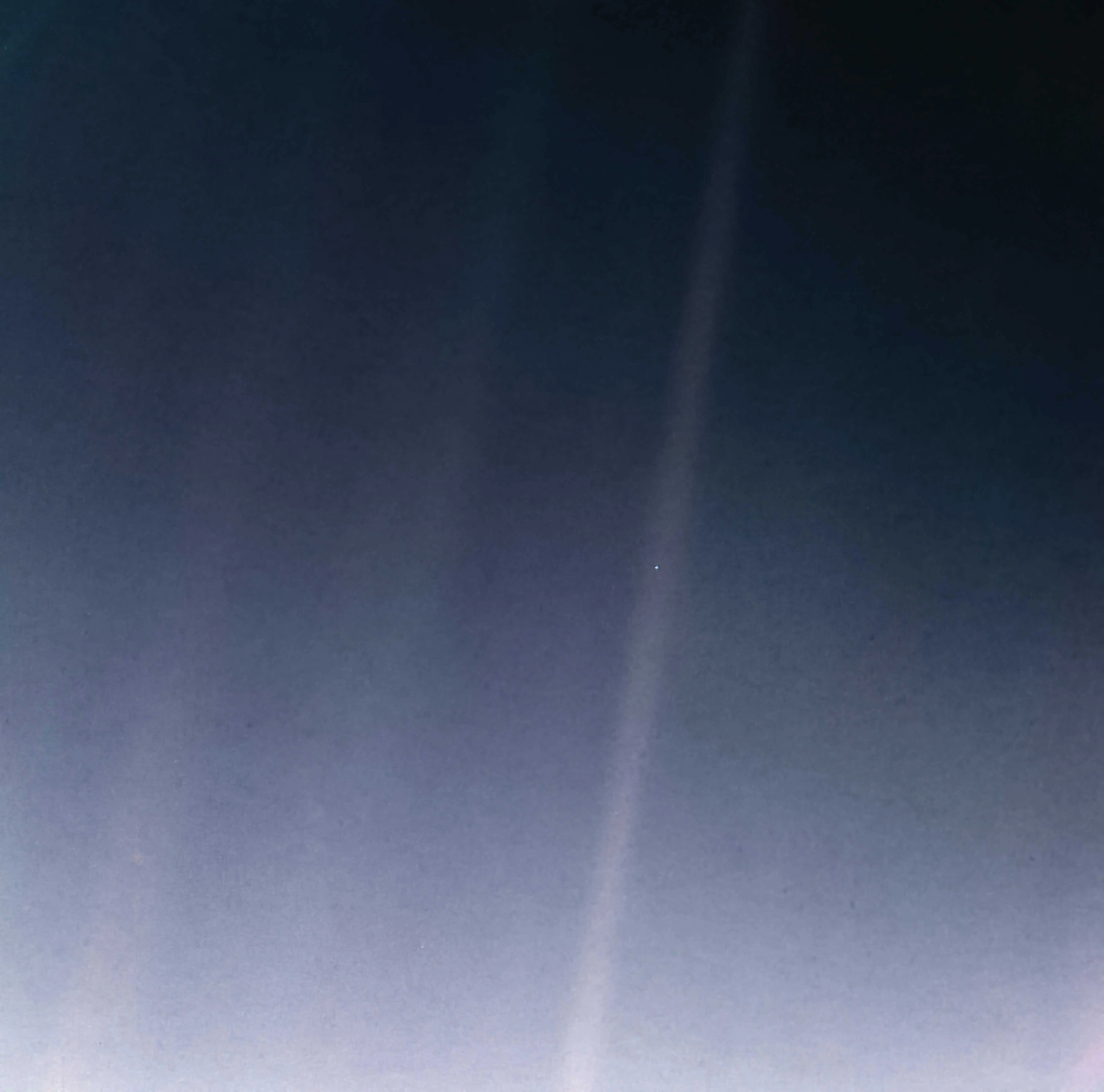
All this made me want to gather an issue of The Rewild that reacquainted readers with their true size—a mote on a pale blue dot in the infinite—and remind us that we can’t be claiming to have created new intelligence if we don’t even understand our own. Let us re-entertain the idea that we don’t exist above nature but on its hospitality. That the alien planet we seek is right here, beneath us, and riddled with a biologic so advanced we can’t even begin to conceive of its origins.
This issue’s contributors reflect on that idea from many angles. Lauren Gillespie and Robin Guilhot write about the majesty of great trees and how they manage to effortlessly draw up water to their highest leaves, where humans have struggled to pull their drinks with coal-burning contrivances. Nick Rahaim reflects on his peripatetic life of labor on a crabbing vessel, and the feeling when shore comes back into view. Jay Standish writes about how early canoeing adventures taught him hardship and made him someone who’ll always choose the portage. Cecilia Seiter writes about her time as a tour guide at the Eames Institute, whose founders implored us to look first to natural solutions. Steve Peck shares the story of how he burned out of tech and found respite in selling solar-powered beehives. And Eve Eden implores us to remain open to the unknown as we consider that the pinnacle of technological advancement may in fact, look a lot more like nature.
Let me leave you with a joke my brother brought home from Catholic school, which isn’t a system either of us subscribe to, but the joke contains humor we can all appreciate. A scientist figures out how to create life. He challenges god to a life-making competition. God shows up with an empty table. The scientist piles his high with dirt and begins slathering it with chemicals. But before he's gotten too far, god shouts, "Wait! Use your own dirt."
Issues
- Why doesn't AI have a childhood? Join a live talk on this April 8, 2026
- The Clearing for Nature Did It Better
- Finding peace on a perilous sea
- Eventually, everything connects
- How do trees water their highest leaves?
- I choose to portage
- AI-powered beehives and other daily joys
- Email nurture is powerfully unnatural
Enjoy,
The Fenwick team