In some ways, Steve’s new promotion left him elated. But it also unsettled him.
His younger self had dreamed of this moment, back at the start of his career, selling water jugs door-to-door in Chicago. Now he was being offered head of revenue at a tech company selling remote sensors to hospitals and restaurants. It was a big step. So why did it leave him feeling uncharacteristically neutral? He gulped down those feelings and accepted.
Soon, he was flying around the world and struggling against the company’s parochialism and complexity, managing layers of people. His mood slipped. He was in London, then San Francisco, then London, then Tampa. Then briefly home with his kids and wife among their fruit trees, then away again. As his morale dissolved, so too went his ability to smile on sales calls as yet another restaurant owner explained how they’d left their freezer open.
Steve knew hard work. It was in his ethic. But in every prior role, he’s always found something to learn. And these refrigerator sensors felt like an achingly dull topic. Calls blurred. Days dragged. With the fun, went his performance and eventually, he couldn’t go on.
For the first time back on the job market in years, he was left wondering, what would it feel like to experience the fire of life at work again?
Buried amidst bones, boxes, and bar codes
Steve was always interested in nature, animals, and insects. His wife jokes that if he were deserted on an island with nothing to do but count insects, he’d be a pretty happy guy. That interest was there from the start. In college, he studied environmental, population, and organismic biology. Upon graduation, peers went into pre-med, but that wasn’t for him, so he took a biology-adjacent job in a soft and skeletal tissue bank. There, for $13.25 an hour, he stocked and shipped body parts.
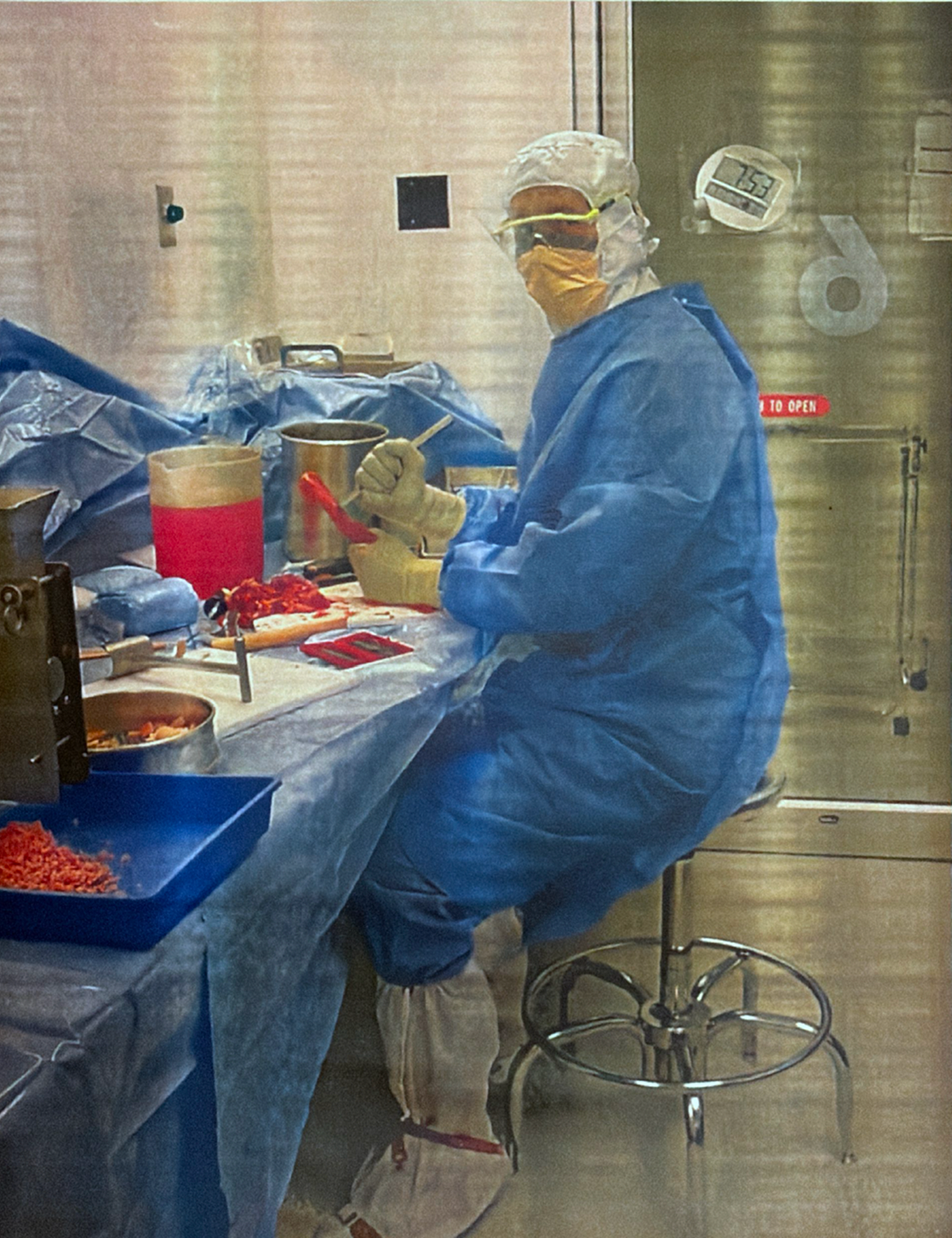
“I would go into the freezer and find a donor bag of separated bones—femurs, patellas, you know, ligaments, different things,” says Steve. He spent 10 to 12 hours per day, four days a week, alone in a windowless clean room sorting and shipping. Just serial numbers, no names, no stories. Bones, boxes, and bar codes on repeat.
“It taught me a lot, and I actually found parts quite interesting,” he says. “But the biggest lesson was I really like engaging with people and I wanted to see natural light and get out into the business world.”
"The biggest lesson was I really like engaging with people.”
Where does one start out in business if you want to make money? Sales. Steve moved to Chicago for a fresh start and took a job selling five-gallon water jugs door-to-door to businesses. It was tough. Each sale, he’d get paid $50. He might knock on 200 doors a day. He was lucky to make two sales. Only later did he learn that Chicago has the second-cleanest drinking water in the country. It was a grind. But interfacing with people? He was good at that. This led him to another job selling topical pharmaceuticals like a lacquer for toenail fungus. That went great until the parent company eliminated the entire sales force, which he learned about upon return from his honeymoon.
But now his career was taking form, and he had the seller’s resilience. Yet again, he reinvented. His wife encouraged him to think even bigger. “You’re struggling down a narrow path, you need to open your horizons,” she said to me. “What’s bigger, even more consultative? What about medical device sales?” So he found a job selling video education packages to hospitals, and felt the winds of momentum.
“Sales is a great way to get to know business,” says Steve. “I didn’t know anything about finance or marketing but I did know how to talk to people to understand their challenges.”
Steve, the son of a commercial real estate executive and a science teacher, had found his way, and doesn’t it seem like a mix of those two disciplines? Though the further he would rise, the brighter sales grew and the dimmer science became.
Then, sensory deprivation
Steve started his own tech company without any funding and sold it. He then jumped to a gigantic corporation, Oracle’s NetSuite, to oversee a sales division. Many people’s careers might have coasted from there, on to a gentle retirement. But something in Steve couldn’t sit still. He couldn’t stop asking questions.
“Eventually my boss sat me down and said, ‘Hey Steve, are we not a billion-dollar company growing 40% year-over-year?’ We were. He said, ‘Is the process we have not working for you and your team?’ And I said, ‘No, it’s working. But …’ And he said, ‘Good. That’s all I need to hear. I just need you to execute. Stop thinking. Execute.’ “And of course he was right,” says Steve. “When you have a sales org of 10,000 people, you can’t keep changing and evolving.”
"Good. That’s all I need to hear. I just need you to execute. Stop thinking. Execute."
The reprimand ricocheted around Steve’s skull as he recalled working in the windowless soft tissue lab. Everything around him was a number. No names. No stories. Bones, boxes, bar codes. Here too. He’d just traded physical items for spreadsheets. Within Steve rose a craving to resume learning. So he flipped his career into something of a reverse.
He joined a UK-based company launching in the U.S. with no sales process, and he built all their workflows, forms, job descriptions, and team from nothing. He was so successful at selling their sensors to hospitals and restaurants that the U.S. operation grew to many millions in recurring revenue. They offered him a promotion to global head of revenue. Of course, you know where this story is headed.
Deadened inside and missing science, Steve revved his career reversal even harder and sped all the way back to the beginning.
“The problem with me is I was helping clients solve a problem that I just fundamentally didn’t care about,” recalls Steve. “People would ask what I did for work and I’d dodge the question with personal answers—mushroom foraging, mountain biking, camping, fishing, and the fruit trees I’d planted in our yard. I didn’t want to talk about work.”
This was his epiphany. Why didn’t he pursue biology at work?
Robot tractors led to AI-powered beehives
Steve dialed the CEOs of businesses where he’d be thrilled to work, like agricultural technology. That led to several conversations and an offer to run revenue at a robotic, electric tractor company. Though his instinct was to refuse it. It seemed too risky.
“I totally discounted the opportunity. It was my wife who reminded me, ‘No, broaden your vision, see where this leads,’” says Steve. “And I realized, yeah, I don’t know much about farming, but I am really excited to learn.”
Steve soon found himself touring farms up and down California, outside, in the sun. He bought a new hat and tougher boots. Sometimes he’d zone out watching the wind sift through the vineyards or cattle herd and think, Yes, this is what’s interesting to me. “In our family, we call our house fruit-topia, but our orchard is very small-time,” says Steve. “Now I was getting to rub elbows with real farmers. They’d tell me their challenges—that their kids didn’t want to inherit those farms because farming was hard, and how it had changed. The drive to mechanize and the brutal economics. I was working with people in ways that were personal, about creating a better life.”
Robotic tractors offered a way for those farmers to cut their workload and avoid ‘nuking the land’ with herbicides. It was also a story about food security, which Steve loved. The more farming consolidates into agricultural megacorporations—the more independent farmers and heirloom breeds are squeezed out—the more fragile the whole ecosystem; and the rougher the transport and the lower the nutrition. Then Steve stumbled on a topic even bigger. Something more scientifically fundamental. A creature that, had he been stuck counting them on a desert island, he’d be a pretty happy guy: Bees.
Steve is now the managing director of a company that manufactures electronic, ‘smart’ hives for bees. In 2024, 62% of bee colonies in the United States died off. That’s due to concurrent plagues of mites and pesticides, which are underreported and something of a Silent Spring moment for the agricultural industry. For there is no mechanical alternative to the work that bees do. For Steve, this was perfect. When moving to Marin, he’d bought a home and inherited two live colonies, and the owner had bequeathed him a bee suit.

“Now I’d find ways to weave work into cocktail conversations and people would be like, ‘No way, what?’” laughs Steve. “There are just so many interesting angles on bees. You’ll have to stop me. Start with the fact that bees are a matriarchal society. Male bees are really only like half-bees because the queen doesn’t have to fertilize those eggs. They have starkly defined roles. The hive decides when to create a new queen and they create one by feeding those eggs royal jelly. Whereas other workers, they get cut off and that stops their development. The drones, their sole purpose is to leave the hive to mate with other queens. I’ve double-checked all this stuff. It gets weirder, I could go on. I guess you could say, I am energized by this. It’s really, really cool. For so long I thought, ‘You’ve got your professional life, and your interests are separate.’ But now I’m into this Japanese concept, ikigai—that’s when you find your purpose, drive change in the world, and get paid for doing what you’re good at. I feel I’m doing that.”
"For so long I thought, ‘You’ve got your professional life, and your interests are separate.’ But now I’m into this Japanese concept, ikigai."
It’s been the ultimate tonic to Steve’s day-to-day. “When I come in, I get to jump into learning about bees.” And, about protecting bees. For there is no replacement.
All of Steve’s pursuits in technology has led him back to using technology to sustain a population of insects that are so complicated, and so efficient, we have no near-term hope of building any kind of replacement. They speak a language of waggling pantomime and pheromones. They can grow to a hive of 80,000 members who all know everyone’s role. It’s fascinating to Steve because it is tech. The original tech. As they say, studying biology is like landing on an alien planet and discovering advanced technology far beyond anything humans can build and then trying to make it work without understanding it.
There’s something delightful and life-giving in that pursuit.